
Skip to content
Menu
Guide · Wagyu

Wagyu: Japan and Australia

Wagyu stands for exceptional meat quality and especially fine fat marbling. It gives the meat its incomparable tenderness, juiciness and typically buttery taste. On our menu you will find two different variants: a Japanese filet from Miyazaki Prefecture graded A5+ and an Australian F1 filet. Both are Wagyu, but differ clearly in origin, marbling and taste. We explain what is behind the terms and what matters with the two variants.

By DOOR No. 8 · October 23, 2026

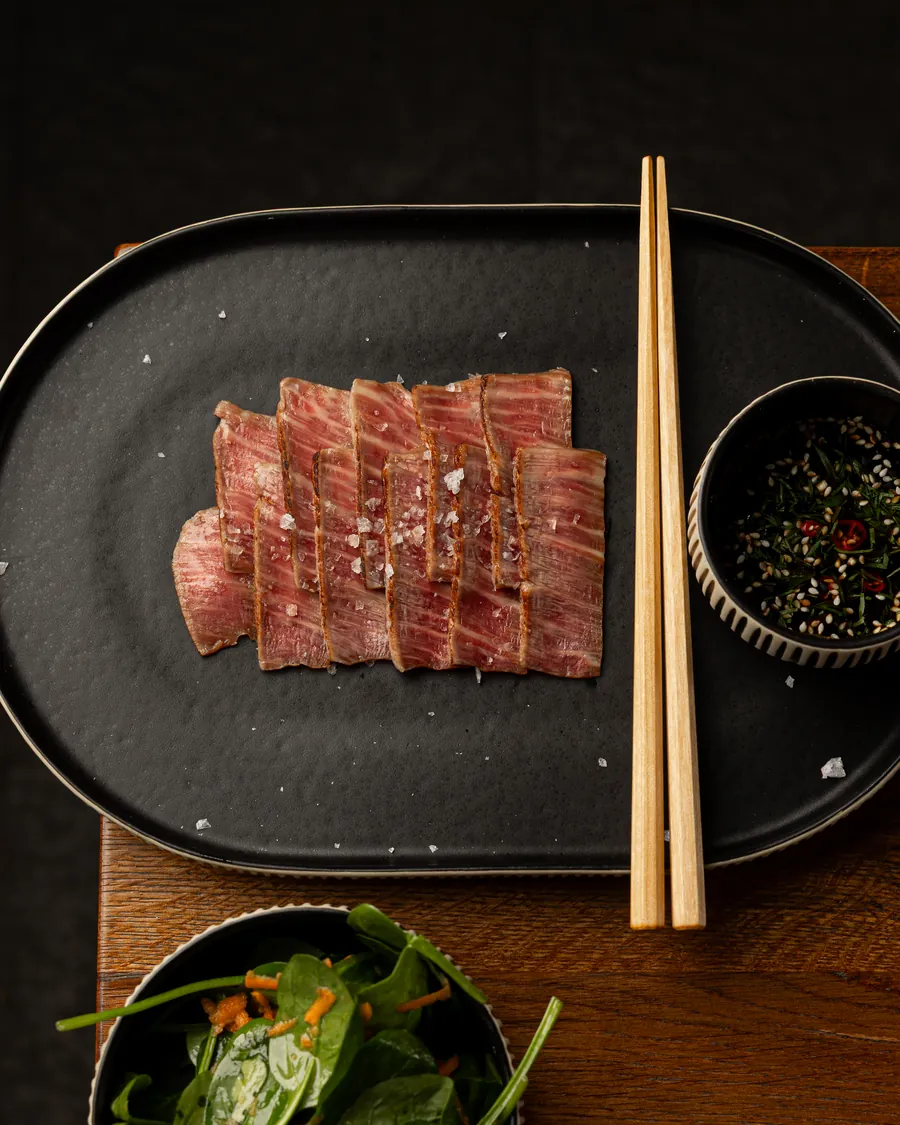
Thinly sliced Wagyu sashimi on a black plate with ponzu jus and chopsticks
Wagyu sashimi

Miyazaki A5+ from Japan

Our Japanese Wagyu filet comes from Miyazaki Prefecture, one of Japan’s best-known Wagyu regions. The A5+ grade stands for the highest quality class of the Japanese grading system. Characteristic is the exceptionally fine and even fat marbling. The so-called Beef Marbling Score (BMS) is around 10 to 12.

In taste this Wagyu is especially intense and buttery-nutty. The fine fat almost melts on the tongue and creates an almost creamy texture. The animals are mainly fed on grain (grain fed). The meat matures for at least 21 days. The age at slaughter is mostly between 28 and 36 months, sometimes above.

F1 from Australia

Our Australian Wagyu filet belongs to the so-called F1 generation. This is a cross of Wagyu and Angus in a 50:50 ratio. F1 stands for “First Filial Generation”, i.e. the first generation of offspring of this cross.

The marbling is pronounced, but somewhat more restrained than with the Japanese A5+. With a BMS of about 6 to 7, this Wagyu offers a balanced combination of tenderness, juiciness and strong meat flavour.

Compared with the Japanese Wagyu it tastes somewhat meatier and more aromatic, with a pleasant bite. The animals are fed both grass and grain (grass & grain fed). This meat also matures for at least 21 days. The age at slaughter is about 24 to 30 months.

In short: Japanese A5+ stands for exceptionally intense marbling and an almost melting texture. The Australian F1 combines pronounced marbling with a stronger, more classic meat flavour.

BMS: the Beef Marbling Score

The Beef Marbling Score describes the degree of fat marbling within the muscle. The scale runs from 1 to 12. The higher the value, the more the meat is shot through with fine veins of fat.

  • BMS 1–2: Hardly any marbling – typical of very lean beef.
  • BMS 3–5: Light to medium marbling – typical of many classic steaks.
  • BMS 6–7: Strong marbling – as with the Australian Wagyu F1.
  • BMS 8–10: Very strong marbling.
  • BMS 11–12: Exceptionally intense marbling – typical of Japanese Wagyu A5+.

The marbling substantially influences the texture, juiciness and taste experience of a steak.

What does A5 mean?

The Japanese grading system has two parts: a letter and a number.

The letter describes an animal’s meat yield, i.e. how much usable meat it provides in relation to the carcass. The grading runs from A to C, with A denoting the highest yield.

The number stands for the quality grade of the meat. Among other things, fat marbling, meat colour, texture and the quality of the fat are assessed. The scale runs from 1 to 5, with 5 the highest quality grade.

A5 thus combines the highest yield with the highest quality rating. The designation A5+ is often used to highlight especially heavily marbled Wagyu within this top class.

For comparison: classic steaks often show marbling in the range of BMS 3 to 5. The age at slaughter for many classic cattle is between 18 and 30 months.

How much Wagyu would you like?

Wagyu is an especially rich taste experience. Because of its high fat content the meat is very intense and filling. That is why a large portion is often not needed to enjoy its special character.

As a guide we recommend about 100 to 150 g for the Miyazaki A5+ and 180 to 250 g for the Australian F1. Each is charged per 10 g. You will find the current prices on our menu.

If you would like to try Wagyu for the first time, you can also begin with a special starter: our Wagyu Sashimi from Miyazaki Filet A5+. Served raw, with ponzu jus, chili, cilantro and baby leaf salad.

When preparing on the grill the rule is: rather short and with a lot of feel. Because of the intense fat marbling we recommend not cooking Wagyu beyond medium rare. That keeps its special texture and the characteristic melt best.

You can learn more about the different degrees of doneness in our article on steak doneness.